Category: Uncategorized

  • Ordering Custom Matches: Five Mistakes That Cost You a Reprint

    Ordering Custom Matches: Five Mistakes That Cost You a Reprint

    Custom matches look like the easiest print job in the world: a little box, a logo, a striker, done. Then the order arrives and the matches are too short to light the restaurant’s tabletop candles, or the logo has vanished into a dark stripe, or the reprint pushes the launch two weeks. Most of what goes wrong with a match order is decided before anyone approves the artwork, in choices that feel too small to matter. Here are the mistakes that show up most often, and how to steer around each one.

    Matching the match to the wrong job

    Stick length is the single most common misfire, because the word “matches” covers products that range from about two inches to four and a half. A standard matchbook or cocktail matchbox runs roughly two to two and a quarter inches, which is right for lighting a cigarette, a birthday candle, or an incense stick. Ask that same short match to reach into a hurricane candle, a fireplace, or a grill and your guests are burning their fingers. Long fireplace and cigar matches exist precisely for that reach, running up to four inches and beyond.
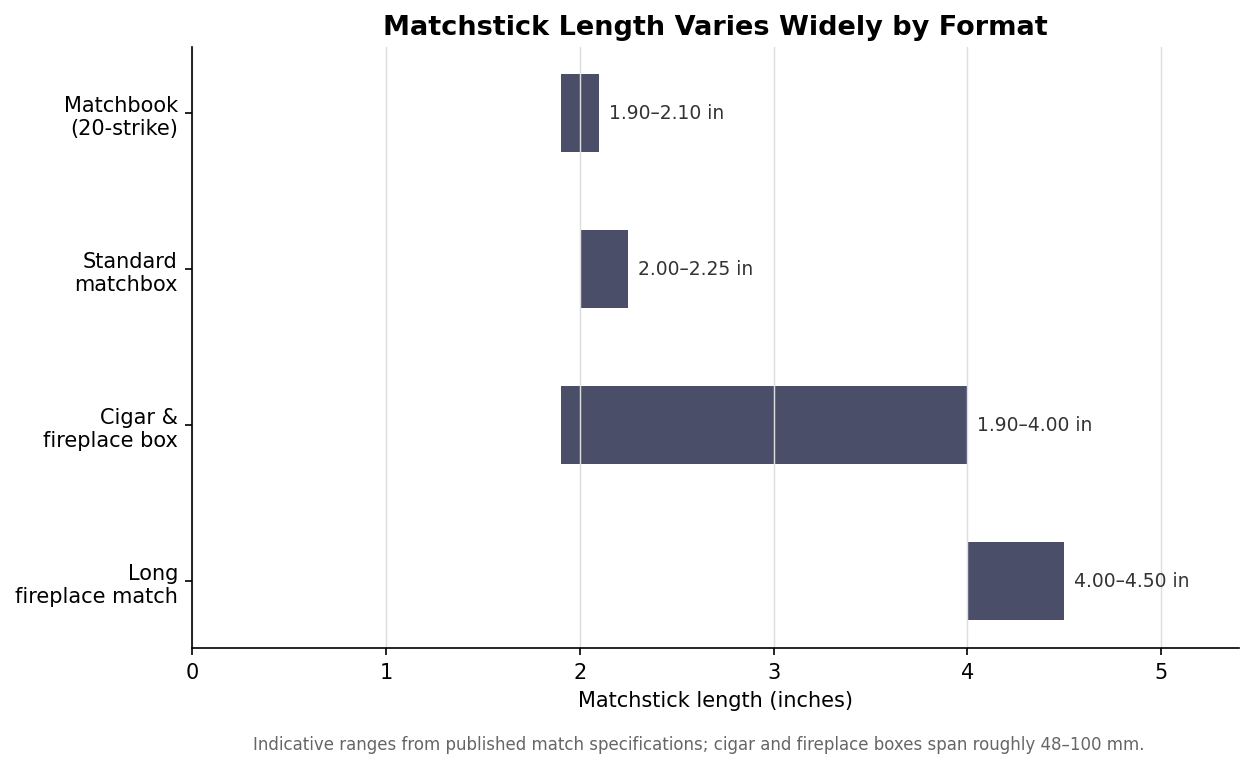
    Horizontal range chart of matchstick length by format from matchbook to long fireplace match
    Match length spans roughly two to four and a half inches across formats; pick the length for the flame you need to reach.

    The fix is to name the actual task before you pick a format. A cigar lounge lighting long-filler cigars wants a four-inch cigar match with a generous head; a cocktail bar lighting tea lights is fine with a two-inch box; a candle brand tucking a match into a gift set should match the stick to the depth of its vessels. Choose the length for the flame you need to reach, then choose the box around it, not the other way round.

    Guessing the count and the minimum

    Match counts are not standardized across formats, and assuming they are leads to either shortages or a garage full of boxes. A 20-strike matchbook holds twenty matches in two rows of ten; a small matchbox tends to hold around thirty; a standard box holds roughly forty; and cigar or fireplace boxes vary widely, often somewhere between ten and forty sticks depending on how long the matches are, since longer sticks simply take more room.
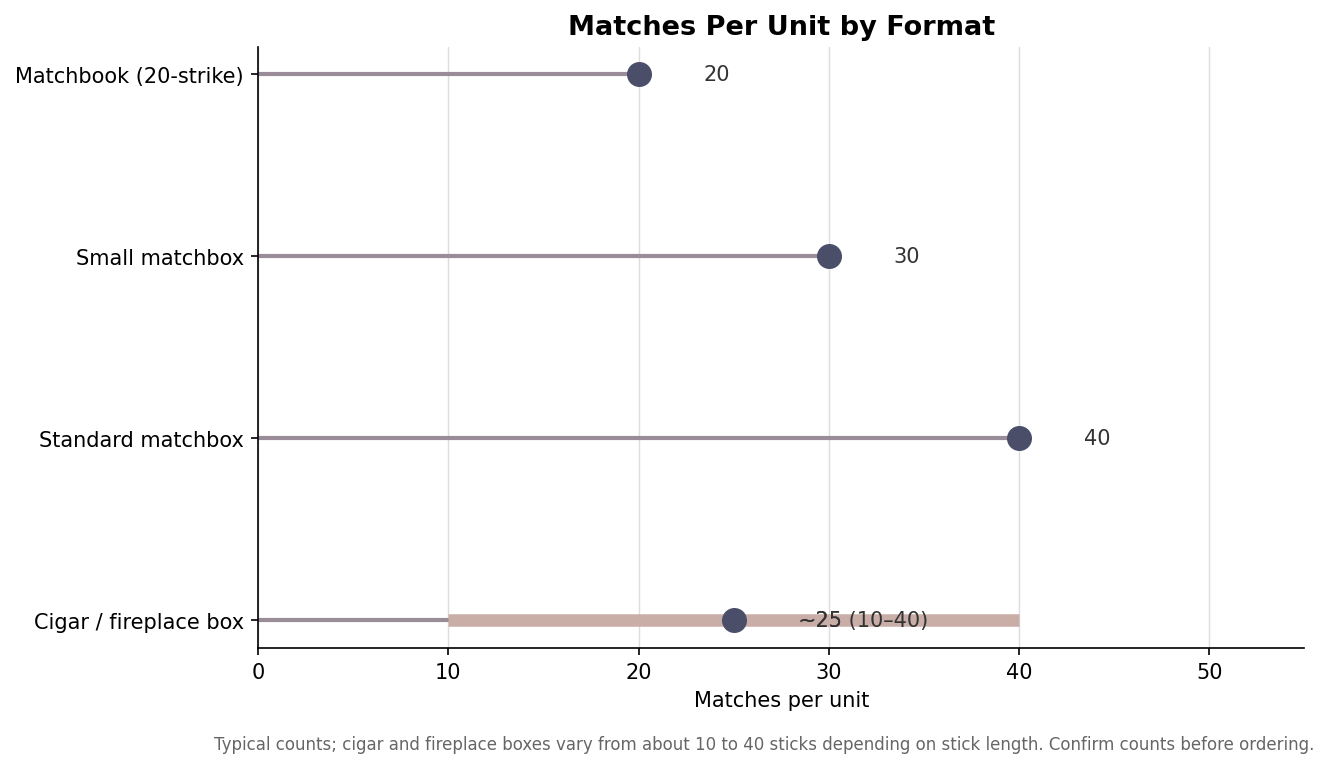
    Lollipop chart of typical matches per unit by format with a range for cigar and fireplace boxes
    Match counts vary by format; cigar and fireplace boxes range widely with stick length.

    Minimums vary just as much by format. Printed matchbooks and simple matchboxes are often available at relatively low minimums, which makes them friendly for a one-off event. Imported cigar and specialty boxes commonly carry much higher minimums, sometimes on the order of a thousand boxes, because they are produced on a different scale. Work out your true need first: how many people, how many uses each, and how many you want left as keepsakes. Then check the minimum for the format you want before you fall in love with it, so the quantity math and the box style agree from the start.

    Designing as if the striker were not there

    A match is one of the few printed products with a working part on its surface, and that part eats into your canvas. The striker has to stay a striker. On a matchbox the striker runs down one or both sides; on a matchbook it sits on the cover, traditionally on the back. Artwork that runs across the strike surface either gets omitted there or interferes with a clean strike, so the usable print area is smaller than the box looks. Plan the design around the striker’s location rather than discovering it in the proof.

    There is a safety wrinkle here too. Ordinary safety matches only ignite against their own treated striker, which is a feature, not a flaw, but it means the striker is not decorative and cannot be buried under a flood of ink. Decide early which surfaces carry your brand and which one stays functional.

    Art that dies at match scale

    A logo that sings on a poster can disappear on a box the size of a stick of gum. Fine hairlines fill in, small text turns to mud, and a dark logo on a dark box vanishes. Contrast and simplicity win at this size. Favor a bold, simplified version of your mark, keep text large enough to read at arm’s length, and give the design real contrast against the box color rather than a tone-on-tone effect that photographs beautifully and reads as a smudge in the hand.

    Color method matters as well. A printed wrap gives you full-color flexibility, while foil stamping delivers a metallic shine but in a single foil color with less fine detail. Neither is better in the abstract; the question is whether your brand lives or dies on a gradient, in which case print, or on a clean metallic monogram, in which case foil earns its keep. Ask to see how your specific art looks at true size before you commit.

    Forgetting matches are a made-to-order, flammable good

    The last mistake is treating matches like a flat print job on a two-day turnaround. They are manufactured to your design and they are a flammable product, which stretches the timeline at both ends. Production alone can run on the order of a week to ten days before anything ships, and specialty imported boxes take longer. Because matches are flammable, transit is handled with more care than a stack of business cards, which adds time rather than saving it.

    Give a match order a comfortable runway. Firm up your quantity, approve a proof shown at actual size, and order well ahead of the event or launch rather than the week before. Handle the five decisions above in order, format to length to count to design to timeline, and the little box that seemed too simple to think about arrives right the first time, striker working, logo legible, and long enough to light whatever you meant it to light.
  • Matchbooks vs. Matchboxes vs. Cigar Matches: Which Custom Format to Order

    Matchbooks vs. Matchboxes vs. Cigar Matches: Which Custom Format to Order

    The first real decision when you order custom matches is not the artwork. It is the format. A matchbook, a slide-out matchbox, and a long cigar match are three different products that happen to share a striking surface, and the one you pick sets your stick count, your burn time, your printable area, your minimum order, and your per-unit cost before a single color is chosen. Getting the format right first makes every later choice easier.

    The three formats, and what actually separates them

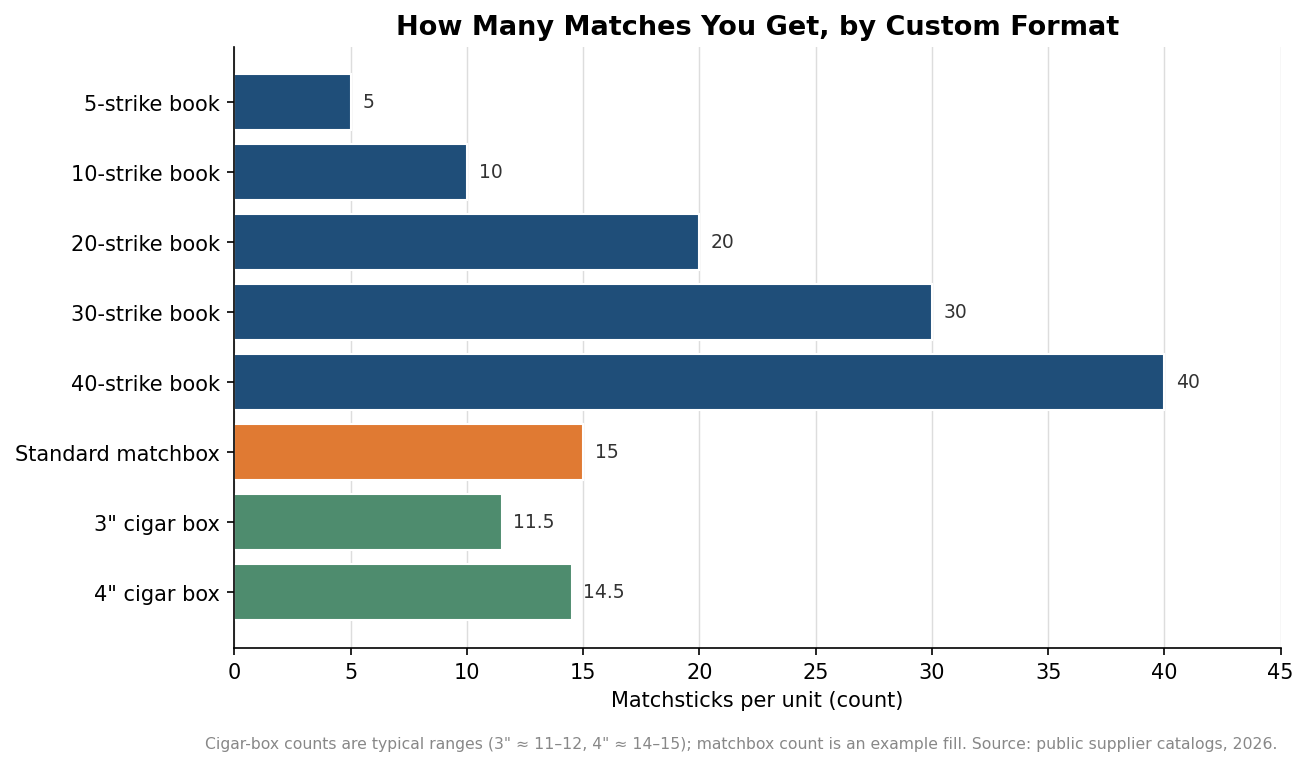
    A matchbook is the flat, foldable cover with a comb of paper matches stapled inside and a striker on the back or front flap. It is the classic bar-and-restaurant giveaway: slim enough to sit in a bowl by the register, cheap in volume, and printable across the front, back, and inside cover. Paper matchbooks come in fixed strike counts, most commonly 20 and 30 sticks, with 5, 10, and 40 also available.

    A matchbox is a two-piece slide box, a printed sleeve around a tray of wooden matches with striker strips on one or both sides. Boxes read as more premium than books because the print wraps a rigid three-dimensional object, and they hold wooden sticks rather than paper combs. A typical rectangular promotional box measures around 56 by 27 by 10 millimeters and holds roughly 15 wooden sticks, though square and cube boxes are common for retail and wedding favors.

    A cigar or long match is a wooden stick well beyond standard length, sold in a tall box. Three-inch sticks run about 11 to 12 to a box and four-inch sticks about 14 to 15, while hearth and fireplace matches stretch to eight, ten, or eleven inches for reaching down into a candle jar or a firebox. The extra length is the point: a longer wooden stick burns slower and keeps the flame away from your fingers.

    Horizontal bar chart comparing matchsticks per unit across matchbook strike counts, a standard matchbox, and three- and four-inch cigar boxes
    Stick count varies widely by format: paper books run 5 to 40 strikes, wooden boxes hold roughly 15.

    Strike count and burn time drive the format

    Match up the format to how the match will be used, not to how it looks in a mockup. A standard paper book match burns for only about 20 to 30 seconds, which is plenty for lighting a birthday candle or a cigarette but marginal for a stubborn cigar or a deep-set candle. A four-inch wooden cigar match can stay lit closer to a minute and produces a cleaner, more even flame, which is why cigar lounges and high-end candle brands specify wooden sticks over paper combs. These burn times are indicative and vary with wood, tip formulation, and humidity, but the ranking holds: longer wooden sticks buy you more lit time.

    Stick count matters for a different reason. A 30-strike book gives a guest more uses per unit, so it lingers and gets seen more often, which is what you want for a brand impression. A 20-strike book is cheaper and lighter for large-volume handouts. A box of 15 wooden matches or a dozen cigar sticks is a keepsake more than a workhorse, so it fits favors and retail shelves rather than bulk counter giveaways.

    What each format costs, and the minimums behind the price

    Format also decides your entry point. Full-color quick-ship matchbooks often start around a 200-unit minimum, foil-stamped and specialty lines commonly begin near 1,000 units, and the cheapest economy stock-color runs usually require 2,000 to 5,000 units before the low headline price applies. In other words, the lowest per-unit cost lives behind the highest minimum.

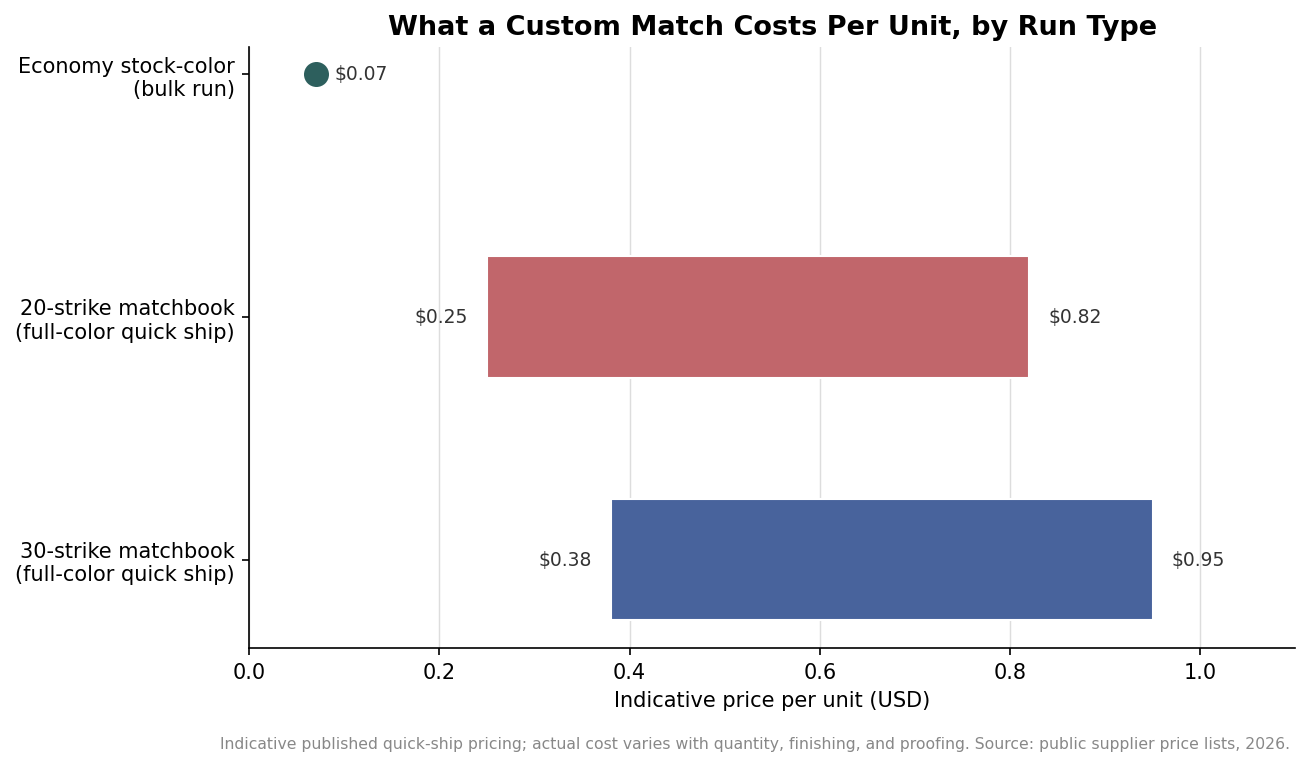
    On a per-unit basis, economy stock-color matches in bulk can land near seven cents each, while full-color quick-ship books tend to run roughly 25 to 82 cents for a 20-strike and about 38 to 95 cents for a 30-strike, depending on quantity and finishing. Wooden boxes and long cigar matches sit higher again because the stick and the rigid box cost more to make. Treat these as indicative published figures rather than a quote; real pricing moves with quantity, ink coverage, and any foil or specialty coating.

    Floating range bar chart of indicative per-unit prices for economy stock-color matches, 20-strike quick-ship matchbooks, and 30-strike quick-ship matchbooks
    Indicative per-unit pricing: economy bulk runs near seven cents, full-color quick-ship books run higher.

    Printing and finishing are not equal across formats

    The formats do not offer the same canvas. Matchbooks give you the most printable real estate for the money, including full-bleed covers, inside-cover printing, and one-to-four color spot or full-color digital work, plus options like foil hot stamping, UV gloss, colored match tips in a range of stock colors, and even printed matchsticks. Slide boxes print beautifully on the sleeve but are constrained by the box footprint, so fine detail needs to be sized for a small rigid panel. Long cigar boxes offer a tall, narrow print field that suits a vertical logo lockup more than a wide wordmark. Decide the artwork’s shape after you have chosen the format, not before.

    Choosing without second-guessing

    Work backward from the moment of use. If the match is a high-volume counter giveaway meant to travel and get seen, a printed matchbook in a 20 or 30 strike is the efficient answer. If the match is a favor, a shelf product, or a premium table accent, a wooden slide box earns its higher cost through the way print wraps a solid object. If someone will actually light a cigar, a deep candle, or a fireplace with it, specify a three-inch, four-inch, or hearth-length wooden stick and accept the higher unit price for the longer, steadier burn. Settle the format first and the sizing, count, and finishing questions mostly answer themselves.

    One planning note on timelines: standard custom match production commonly runs about four to six weeks after proof approval, while quick-ship programs can turn full-color books in under 12 business days and some stock formats ship in as little as 5 to 10 days. If a launch or an event has a hard date, let the lead time, not just the look, help pick the format.