If you’ve priced out custom matches for a wedding, a bar opening, or a candle brand launch, you’ve probably noticed the numbers swing wildly — a box of 50 personalized matchboxes can run $18 or $95 depending on where you order and what finish you pick. That spread isn’t random. It comes down to three variables: order quantity, print method, and whether you’re buying matchbooks (the paper kind with a striker strip) or matchboxes (the small sliding-tray kind, often used for favors). This guide walks through what suppliers are actually charging right now, what quantities trigger the best per-unit price, and how long production really takes once you submit artwork.
None of the figures below are estimates pulled from a rate card years out of date — they’re pulled from current supplier pricing and MOQ pages as of August 2026, with sources named so you can verify them yourself before you commit to an order.
Source: Compiled from The Match Muse, Quality Logo Products, MyBoxPrinting, and Same Day Rush Printing supplier pages, accessed August 2026
What custom matches actually cost
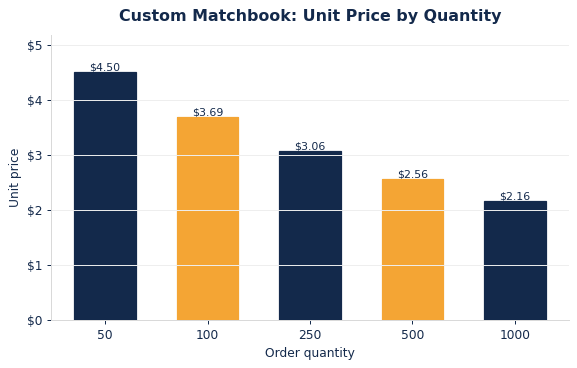
Price per unit drops fast as quantity climbs, then drops again once you cross into bulk-run territory. On the low end, Quality Logo Products lists personalized matchbooks starting around $0.08 each and match boxes as low as $0.06 to $0.11 per unit, with each matchbook holding 24 matches. Their 12-stem specialty matchbook — a narrower 1.75-inch format with a choice of 17 stock tip colors — runs closer to $0.24 each, reflecting the smaller stem count and niche format rather than a premium finish.
Move up to full-color, front-and-back printed matchbooks in the 250–2,500 unit range, and expect $0.25–$0.75 per book, according to pricing compiled in Roll Your Own Papers’ 2026 matchbook guide. That’s the range most bars, restaurants, and event planners land in for a standard branded order. Wedding-favor matchboxes follow a similar curve: basic personalized boxes start around $0.15 each, sets of 50 with a simple design run about $0.37 per box, and the same quantity with metallic foil printing jumps to roughly $0.55 per box. Fully custom-designed boxes — hand-matched to invitation suites — can reach $1.49 each.
The expensive end of custom matches pricing is consistent across suppliers: low quantities (under 100 units), rush production, and specialty finishes like foil stamping or textured covers each push per-piece cost into the $1.00–$2.00+ range. Stack two of those — say, a rush order of 75 foil-stamped matchboxes — and you’re paying boutique pricing, not bulk pricing, no matter which vendor you use.
| Match Style / Order Type | Price Per Unit |
|---|---|
| Matchboxes (basic, bulk) | $0.06 – $0.11 |
| Standard matchbooks (250–2,500 qty, full color) | $0.25 – $0.75 |
| 12-stem specialty matchbook | $0.24 |
| Wedding favor matchbox, foil finish (sets of 50) | $0.55 |
| Fully custom-designed favor matchbox | $1.49 |
| Low-qty (<100), rush, or foil-stamped matchbooks | $1.00 – $2.00+ |
Minimum order quantities for custom matches
MOQs vary more by product style than by vendor. Satin-wrapped matches — a wrapped bundle style popular for small favor orders — have the lowest bar to entry, with The Match Muse setting its minimum at just 24 pieces. Their factory-printed line, which uses a more industrial CMYK press process, steps the minimum up to 100 pieces. IBEX Packaging quotes a comparable 100-unit minimum for custom matches generally, which is low enough to cover a single small event without over-ordering.
Once you move into printed matchbooks meant for branding rather than one-off favors, minimums climb. Promotional Matches sets a 200-unit floor on its matchbox line, and OH WHAT A MATCH’s short-run digitally printed matchbooks start at 200–1,000 units depending on the design complexity. If you only need a few dozen for a small dinner party or engagement shoot, a satin-wrapped or factory-printed supplier with a sub-100 minimum will save you from paying for hundreds of extras you don’t need.
| Supplier / Product Line | Minimum Order Quantity |
|---|---|
| The Match Muse — satin-wrapped matches | 24 pieces |
| The Match Muse — factory-printed matches | 100 pieces |
| IBEX Packaging — custom matches | 100 pieces |
| Promotional Matches — matchboxes | 200 pieces |
| OH WHAT A MATCH — short-run digital matchbooks | 200 – 1,000 pieces |
Matchbooks vs. matchboxes: which style fits your order
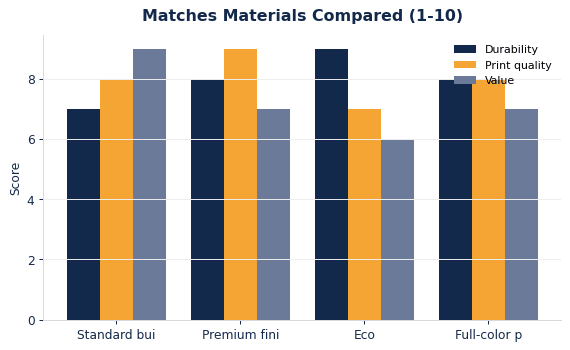
Matchbooks — the flat paper kind with a striker strip on the back cover and a row of stems folded inside — print well in full color across the entire cover, which is why bars and restaurants favor them for logo work. A standard matchbook holds around 24 matches, giving you a bigger canvas for a wordmark or illustration than the narrower stem count on specialty formats.
Matchboxes — the small sliding-tray boxes — read as more decorative and are the default choice for wedding and event favors, since the box itself doubles as a keepsake. They tend to be the cheaper option per unit at bulk quantities, but foil stamping and fully custom art (matching an invitation suite, for example) can erase that cost advantage quickly, as the $0.55–$1.49 per-box range above shows.
If you’re ordering custom matches for retail shelf presence — say, alongside candles — matchboxes with a printed sleeve tend to look more premium for a similar cost to a plain matchbook. If you’re ordering for a bar counter or check presenter, matchbooks are the more familiar, more durable format and cost less at volume.
Lead times, rush options, and proofing
Standard production for custom matches typically runs 5–10 business days after you approve a proof, with total delivery — production plus shipping — landing around 7–12 working days for most suppliers, including MyBoxPrinting’s stated 5–10 business day window. Some specialty formats take longer: tent-style matchbooks and matches packed in drum boxes can carry production windows closer to several weeks rather than days, so confirm the timeline for your specific style before you commit to an event date.
If you’re ordering close to a deadline, rush service exists but costs more. The Match Muse advertises a 24-hour rush option for print-ready artwork, and several promotional printers offer similar same-day or next-day service for matchbooks specifically. Expect a rush surcharge on top of your per-unit price — treat any rush quote as a separate line item, not a small add-on, since expedited labor and shipping are usually priced at a premium rather than a flat fee.
Whatever the timeline, budget for a proofing round. Nearly every supplier builds in at least one digital proof before matches go to press, and the production clock generally doesn’t start until you sign off on it — so a slow turnaround on your end delays the ship date by the same number of days.
What to prepare before you order
Have print-ready artwork ready before you request a quote — vector files (AI, EPS, or high-resolution PDF) move through proofing faster than a logo pulled off a website. If your design uses foil, metallic ink, or a texture finish, ask the supplier to confirm those are available on the specific product line you’re ordering, since not every matchbook or matchbox style supports every finish.
Ask about setup fees up front. Many suppliers charge $50–$100 per order for plate or die setup, separate from the per-unit price — that fee gets absorbed easily on a 1,000-unit order but can double your effective cost on a 100-unit run. Finally, confirm the striker strip and match head color if brand consistency matters; these are usually configurable but aren’t always shown clearly in an online quote builder.
Frequently asked questions
What’s the cheapest way to buy custom matches in bulk?
Plain matchboxes without foil or specialty finishes are the least expensive option, running $0.06–$0.11 per unit at bulk quantities from suppliers like Quality Logo Products. Sticking to a one- or two-color print and ordering above the 250-unit tier keeps you out of the higher rush and low-quantity price brackets.
What is the minimum order for custom matches?
It depends on the product style. Satin-wrapped matches can go as low as 24 pieces, factory-printed matches and general custom matches typically start at 100 pieces, and printed matchbook lines often set a 200-unit floor.
How long does it take to get custom matches printed?
Standard production is generally 5–10 business days after you approve a proof, with total delivery closer to 7–12 working days once shipping is factored in. Rush service can bring that down to as little as 24 hours for print-ready artwork, at an added cost.
Are matchboxes or matchbooks better for wedding favors?
Matchboxes are the more common favor choice since the small sliding box works as a keepsake alongside the matches. They’re also typically cheaper at low-to-mid quantities than a fully printed matchbook, though foil stamping or fully custom art can push the price above a comparable matchbook.
Do custom match orders include a setup fee?
Many do — commonly $50–$100 per order for plate or die setup, charged separately from the per-unit price. Ask for this figure explicitly when you request a quote, since it changes the effective cost more on small orders than large ones.
The bottom line
Custom matches are one of the few promotional products where the cheapest listed price and the price you’ll actually pay can be far apart — quantity, finish, and turnaround speed do most of that work. Order above the 250-unit mark where possible, keep finishes simple unless the design calls for foil, and build in the standard 5–10 business day production window rather than assuming rush service by default. Get a quote that itemizes the per-unit price, setup fee, and shipping separately, and you’ll know exactly what a batch of custom matches costs before you place the order.